- What is NeuroMarketing (NM)?
- What are some of the applications of NM?
- Has NM delivered on its promises?
- What was the Pepsi challenge?
- What is Applied Neuromarketing?
- Why is Applied NM also known as the science of persuasion?
- What is the loss aversion bias, and why does it matter in marketing?
- Why translate the 188 cognitive biases into 6 primal stimuli?
- Why further translate the 6 primal stimuli into 4 steps?
- Are NM and Applied NM ethical?
- What about AI and NM?
- Are NM and Applied NM worth learning about?
No, marketing doesn’t work!
It doesn’t work because marketing is about asking the prospects, “What do you want?” and based on their self-reported, conscious answer, it’s about building a product and later a strategy to sell that product. But the problem is that prospects DON’T KNOW WHAT THEY WANT…. They cannot consciously formulate what they really want. For example, in 1985, consumers told Coke that they were interested in a new, reformulated version of Coke. It was supposed to better compete against Pepsi. Within just 77 days of the introduction of New Coke, the original formula, now called Coca-Cola Classic, was reintroduced because, despite all the users’ groups’ feedback that had indicated an interest in New Coke, the vast majority of the loyal customers rejected the new version.
Similarly, many consumers might report: “I prefer chocolate ice cream over vanilla”, to which the wise marketing driven ice cream manufacturer would produce 70% of chocolate ice cream and only 30% of vanilla. Yet in the middle of the peak ice cream season, the manufacturer realizes they have run out of vanilla! Amazingly, the consumers are not even aware of why they flipped their preference to vanilla. It may be because there was a temperature decrease of half a degree Fahrenheit last month or because they read some news stating that the worldwide cocoa production increased by 2%, making it a more commoditized, less desirable product. In the end, the processes that drive consumers’ choices are more non-conscious than conscious, and they cannot be accurately reported by traditional marketing
As you will learn, these processes are not driven by our rational brain, they are driven by our primal brain!
What is NeuroMarketing (NM)?
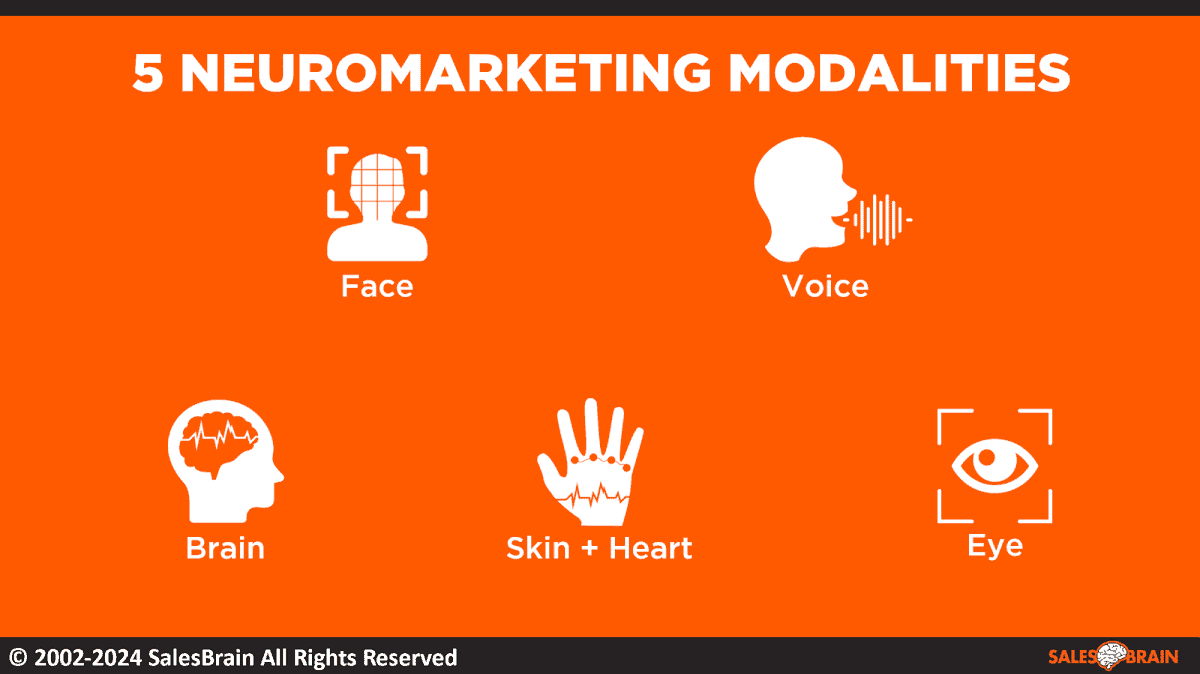
Starting in the early 2000s, the promise of NM has been to access some of these unconscious preferences or biases. In NM, we ask the consumers “what do you want?” but we will not blindly trust their answers; instead, we will measure directly on their bodies various physiological changes that would indicate more accurately than their self-reported answers what they really want. Various modalities are used, including:
- Facial coding, where emotions are measured by the patterns of contractions of the 43 facial muscles
- Voice analysis, which measures changes in the tone of voice
- EMG and Functional MRI, which measure different types of brain activities
- Skin conductance and heart rate changes
- Eye Tracking, which measures the position of the eyes of the consumer when they see a visual stimulus such as an image or a video
What are some of the applications of NM?
Some of the most direct applications have been:
- Ad Effectiveness: Testing which advertisements generate the strongest emotional and visual impact
- Website & user interface Optimization: Designing digital interfaces that naturally guide users toward conversion
- Packaging & Branding: Choosing colors, shapes, and visuals that appeal to the brain’s reward system
- Pricing Psychology: framing prices attractively, e.g., charm pricing like $9.95
- Storytelling & Persuasion: Crafting messages that engage the brain’s narrative processing and memory retention.
Has NM delivered on its promises?
This whole field was very promising when it first started in the early 2000s, but retrospectively, it didn’t deliver the almost miraculous results that a lot of marketing experts expected and publicized.
Between 2005 and 2015, several companies such as Nielsen– the media rating company– invested heavily in NM. For example, Nielsen bought NeuroFocus, a firm specialized in NM, and they jointly opened dozens of NM labs throughout the world. But in September 2020, Nielsen closed 90% of those labs. Why? Because those measurements couldn’t be easily translated into tangible marketing changes that would positively persuade more buyers.
What was the Pepsi challenge?
A good example of this is the now famous research project called the Pepsi Challenge, released in 2004 by the Baylor College of Medicine in Texas. It didn’t make sense that Coke outsells Pepsi by a factor of 3 when, in double blind testing, consumers express an actual preference for Pepsi. So the researchers decided to put 67 consumers into an fMRI and asked them which of Pepsi and Coke they preferred. The study demonstrated that despite a tendency to prefer Pepsi, when the consumer is told that they drink Coke, various areas of the brain are activated, and those override the initial preference for Pepsi.
- Blind Taste Test
- When participants were given Pepsi and Coca-Cola in a blind taste test, brain activity was recorded in the nucleus accumbens, a region associated with pleasure and reward.
- The results showed that more participants preferred Pepsi in this condition, as the nucleus accumbens became more active when drinking Pepsi.
- Branded Taste Test
- When participants were told which brand they were drinking before tasting, a different pattern emerged.
- Those drinking Coca-Cola showed increased activity in the frontal lobe, an area associated with higher cognitive processes such as memory and rational decision analysis.
- Despite Pepsi being preferred in the blind test, when participants knew they were drinking Coke, they reported a stronger preference for it.
- Branding Overrules Taste Preferences
- The study demonstrated that Coca-Cola’s powerful branding and marketing campaigns embedded strong emotional associations which overrode the sensory pleasure response in consumers’ brains
- This branding effect essentially “hijacked” the decision-making process, leading people to prefer Coke despite preferring the taste of Pepsi when unaware of the brand.
The results were hardly a surprise! The impact of branding had been known for a long time, and sadly, the marketing team at Pepsi didn’t learn anything they could use to sell more Pepsi vs Coke.
What is Applied Neuromarketing?
Now, while all this fervent activity was happening in the field of NM, a researcher named Daniel Kahneman received the Nobel Prize in Economy. His groundbreaking discovery was published in the now-famous book “Thinking Fast and Slow”, where Kahneman demonstrated that we don’t have 1 brain, we have 2 brains: The fast Primal Brain and the smart but slow rational brain. He named these two brain systems 1 and 2. He further showed that although we think of ourselves as a smart species, we are still under the dominance, some would even say the tyranny, of system 1, our primal brain. Kahneman wrote: “System 1 still rules today”.
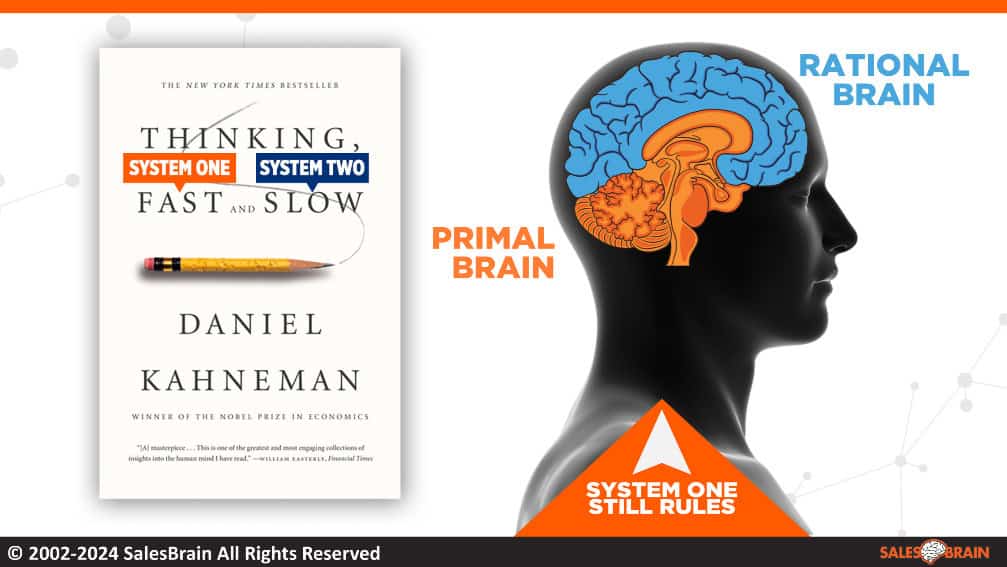
Building on Kahneman’s discovery, Applied NM is about making all marketing actions more effective by providing a scientific roadmap that explains and optimizes the role of each brain in the decision-making process. The objective is to facilitate a positive decision by making both the primal and the rational brains agree on the best option for the consumer.
Why is Applied NM also known as the science of persuasion?
At SalesBrain, we decided to investigate Kahneman’s findings and to specifically apply them to sales and marketing… that’s how applied NM started.
In applied NM, we looked at the working principles of the primal brain. This provides a blueprint to explain scientifically — call it rationally — why Homo Sapiens is not rational and how we can use these findings to improve marketing. Kahneman and other researchers have discovered 188 cognitive biases or rules of human non-rational behaviour. These describe scientifically how we evaluate information, compare options and trigger decisions. It also provides a proven model to influence people! Kahneman himself discovered a few of those 188 biases. Let us describe possibly the most important one, the one that explains why it is always hard to sell: it is called the loss aversion bias.
What is the loss aversion bias, and why does it matter in marketing?
In this test, Kahneman asked a large number of people to choose between 2 options:
- Either they could decide to receive $10
- Or a coin would be flipped, and they would receive 0 if it landed on heads, but they’d receive $20 if it landed on tails.
The vast majority of people chose the first option, although from a statistical perspective, both options provide the same gain expectation.
Then Kahneman asked the same people to choose from 2 new options:
- Either they could decide to give away or lose $10
- Or a coin would be flipped: they would need to pay nothing if it landed on heads, but they would need to give away $20 if it landed on tails.
Here, the majority of people chose the second option. Note that it doesn’t make sense: if we were rational, we would be symmetrical in our win vs lose choices. The Loss aversion bias had just been discovered.
Another group of researchers was even able to quantify that dissymmetry in the loss aversion bias. And the magic number they discovered is 2.3…. Here is what it means. Imagine you are trying to sell a pen worth $2.30. If your customers were not afflicted by the loss aversion bias, i.e. if they were rational, they would be willing to pay $2.30 to acquire that pen: that’s the definition of a win/win transaction. But because of the loss aversion bias, science proved that the consumer only wants to pay $1 to receive something valued at $2.3. The negative emotion of losing $1 can only be counterbalanced by the positive emotion of receiving something worth $2.30, not $1.00!
The marketing conclusion is that it will always be difficult to sell because the customers are only willing to pay 2.3 less than the value they perceive. Amazingly, this also explains the consumer attraction to sales offering a 50% discount: that 50% almost offsets the 2.3 aversion bias!
Why translate the 188 cognitive biases into 6 primal stimuli?
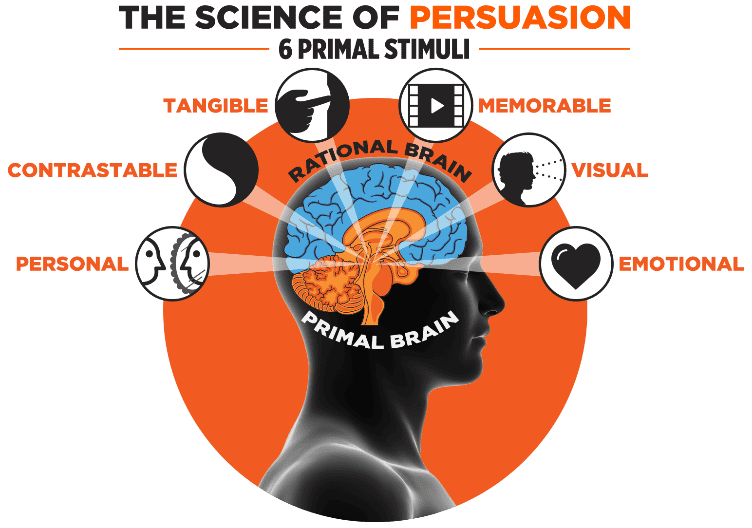
Many of these biases involve very complex brain processes, and it can be difficult or even impossible for the lay marketer to use them to improve their sales and marketing. So, we at SalesBrain have translated these 188 cognitive biases into 6 stimuli. These represent the easiest, fastest and most effective way to communicate directly with the unconscious but dominant primal brain.
The Primal Brain is hardwired to respond to six key stimuli:
- Personal – People care about their own survival, needs, and interests.
- Contrastable – The brain detects clear differences (before/after, cold/warm).
- Tangible – Simple, concrete, and easy-to-understand messages work best.
- Memorable – The brain remembers information best when it is structured and repeated
- Visual – Vision dominates all other senses; 90% of information transmitted to the brain is visual.
- Emotional – Decisions are driven by emotion before logic.
Why further translate the 6 primal stimuli into 4 steps?
Sadly, neither the 188 cognitive biases nor the 6 stimuli provide a simple process that will help marketing professionals increase their persuasion capacity. By providing a simple step-by-step process, the marketers will find:
- Efficiency & Clarity – A structured process makes it easier to diagnose, design, and deliver persuasive messages
- Predictability – It ensures consistent results in all marketing communications by following a tested framework
- Actionability – Marketers and sales teams can apply the theory directly to messaging, branding, and customer engagement… without getting a PhD in neuropsychology!
The 4-Step Persuasion Process: PAIN → CLAIM → GAIN → PRIMAL BRAIN
To maximize the impact of the 6 stimuli and the 188 biases, they can be embedded into 4 practical steps presented in NeuroMap®, the awarded SalesBrain model.
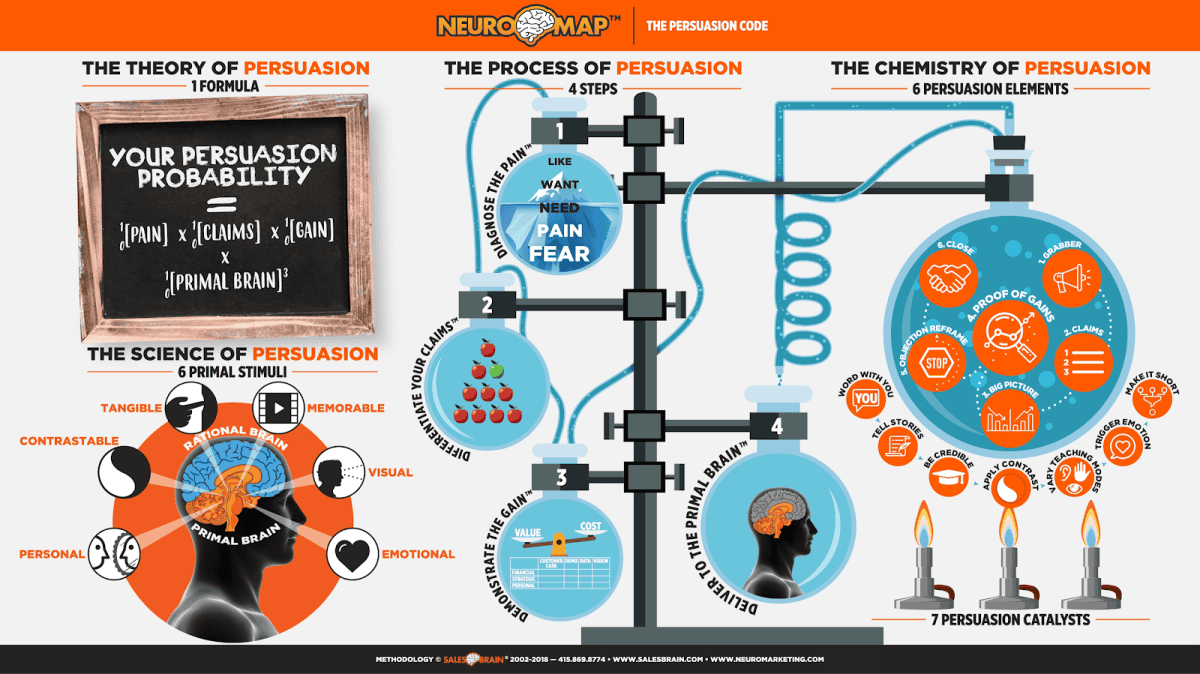
- Diagnose the PAIN
- Identify your audience’s biggest frustration, fear, or problem…. not just their wants or likes
- Use contrast to highlight the pain (e.g., before vs. after using your product).
- Let them talk: Spend more time diagnosing their pain than talking about your products
- Differentiate Your CLAIMS
- Focus on the 3 unique benefits your solution brings to eliminate their PAIN
- Write the book “Why buy from us?” under only 3 chapters: those chapter titles are your CLAIMS
- Keep your CLAIMS simple, tangible and mnemonic so the brain processes them easily.
- Repeat your CLAIMS tirelessly: these will become the essence of your brand.
- Demonstrate the GAIN
- There are 3 kinds of value: financial, strategic and personal
- And there are only 4 ways you can prove those values to both the primal and the rational brain. Those are: customer cases, demo, data, and vision
- Contrast the total VALUE you can now prove with the COST of your solution.
- GAIN = VALUE – COST. Don’t just talk about the GAIN, demonstrate it beyond a reasonable doubt!
- Demonstrate the GAIN
- The acute marketer will notice that the first 3 steps determine the “what to say”. The 4th step is about the “how to say it” or how to:
- Grab and hold the attention of the audience
- Communicate the value or GAIN proposition in 7 seconds or less. Hint: it can often only be made visually, not with text!
- Keep the message short, engaging, and emotionally charged
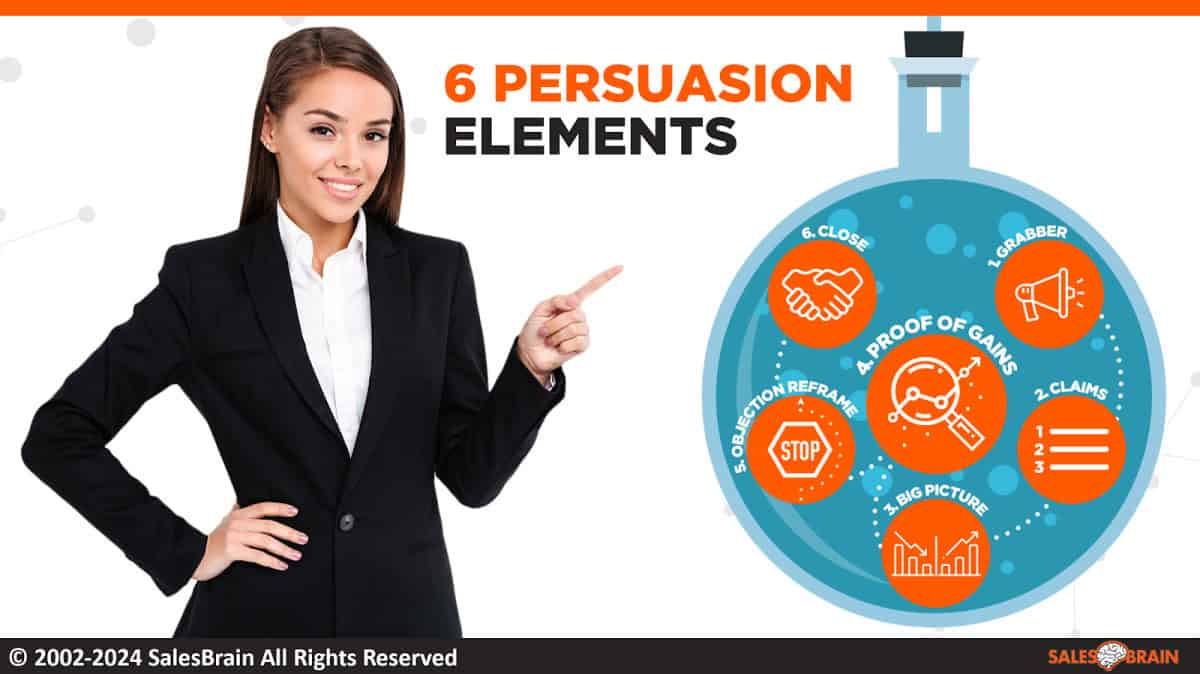
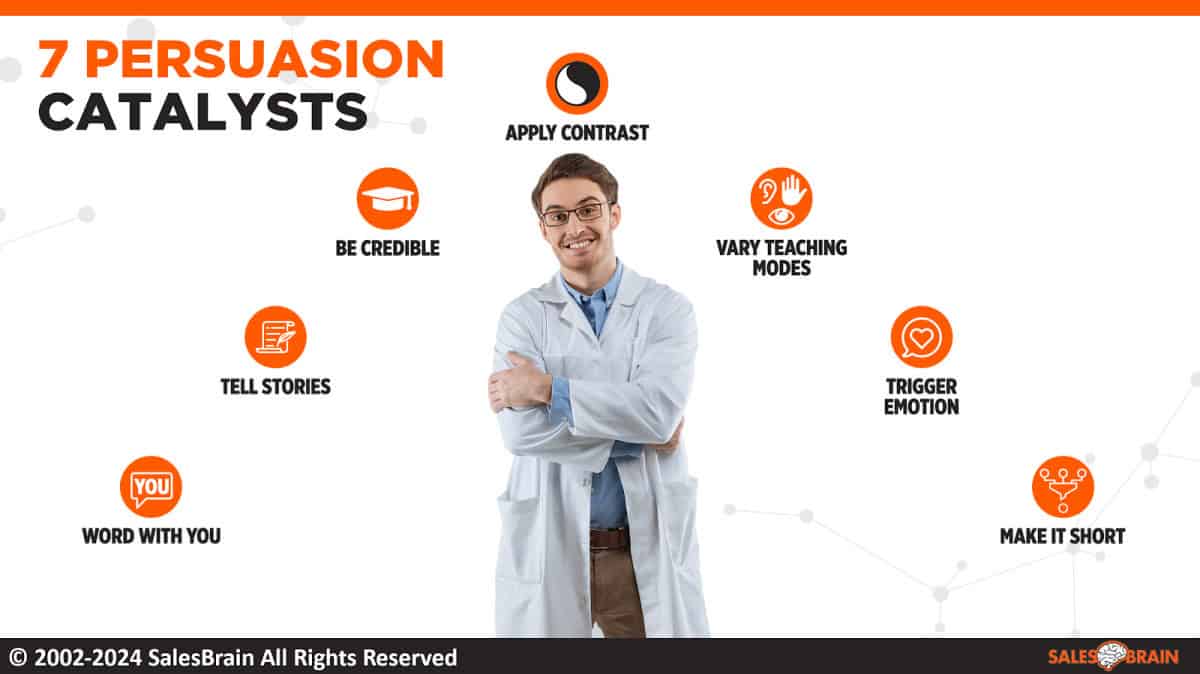
- Use 6 persuasion elements and 7 persuasion boosters
Key Takeaway
- The 6 stimuli explain how the brain responds to persuasion
- The 4 steps turn those insights into a structured, easy-to-apply process
- Following this method ensures maximum engagement, retention, and action from the consumers
Are NM and Applied NM ethical?
Both these new approaches to marketing are ethical when used to enhance consumer experiences rather than manipulate them. It helps businesses create more relevant, engaging, and effective messages based on how the brain processes information. However, ethical concerns arise when it is used to trigger fear-based decision-making or deceive consumers with false information. To remain ethical, these techniques should prioritize transparency, consent, and the consumers’ true well-being, ensuring that marketing strategies inform and persuade rather than manipulate.
What about AI and NM?
The main AI engines are already changing the way marketing professionals work to improve the impact of their communication. Today, anybody can create better emails, voicemails, webpages, brochures, PowerPoint presentations or even videos by simply asking:
- ChatGPT (OpenAI),
- Bing (Microsoft),
- Einstein (Salesforce)
- Search (Google)
- … or else
to write or rewrite some of their content. To the degree that the AI engine is already well educated, the content it will generate will often be more persuasive than the content generated by a novice marketer.
Beyond these, AI responses can be made more persuasive using custom AI versions that have been specifically trained on NeuroMap®. For example, a custom version of ChatGPT called NeuroMap® GPT has already been trained on the 6 stimuli, the 4 steps, the 6 persuasion elements and the 7 persuasion catalysts. The results presented by such an AI model are impressive: it creates truly persuasive messages!
Are NM and Applied NM worth learning about?
Yes, neuromarketing and applied neuromarketing are worth learning about because they provide new and scientific insights into how the brain makes decisions, helping businesses craft more effective and more engaging messages. Understanding these fields allows corporations to optimize ads, websites, branding, and sales strategies based on real neuroscience rather than guesswork. Additionally, applied neuromarketing helps turn these insights into actionable steps, ensuring practical benefits in marketing campaigns.
Whether in sales, advertising, UX design, branding or top management, such as CMO, CSO or CEO, learning neuromarketing will provide a competitive edge by aligning strategies with the way prospects actually think and choose.