
- Enter OpenHR™: A New Blueprint for Blended Workforces
- Inside the OpenHouse: Four Pillars of the OpenHR™ Framework
- Building Foundations for Success: OpenCulture & Psychological Safety
- Why Shift Now? Advantages of the OpenHR™ Approach
- Open Talent in Action: Leading Case Studies
- Risks of Traditional HR in the New Era
- How to Implement OpenHR™: Strategies for Leaders
- Alibaba: Transforming Collaboration with Open Talent Networks
- Final Words: Embracing the Future of Work
A seismic shift in the future of work is happening right now – and most leaders are not prepared. In just three years, half of every workforce will be a blend of permanent employees and Open Talent: independent experts, contractors, and freelancers.
This isn’t simply adapting to change; it’s a ground-breaking transformation of what businesses need to thrive in the 2030s and beyond. The new blended workforce demands urgent action – are your organisation and its HR leaders ready to harness its full potential?
The Open Talent revolution is a wake-up call for everyone and is rapidly reshaping the landscape of work by integrating a myriad of employment types, each offering unique advantages. As companies pivot to this model, understanding and leveraging the blended workforce is key to thriving amidst the complexities of today’s digital economy.
This demands a change. A new HR manifesto and framework for a blended workforce.
Enter OpenHR™: A New Blueprint for Blended Workforces
As HR leaders navigating the rapidly shifting landscape of modern work, it’s essential to craft a blueprint that welcomes and supports every employee, regardless of their role, work preference, or location. Authors of ‘OpenHR – The human capital framework for a blended workforce’, Jeremy Blain and Dr. Rochelle Haynes, envisioned their OpenHR framework as a holistic “home” where the principles of relationships, well-being, and belonging are at the forefront. Their OpenHouse, designed with the future in mind, ensuring organisations are equipped for the challenges of the 2030s and beyond.
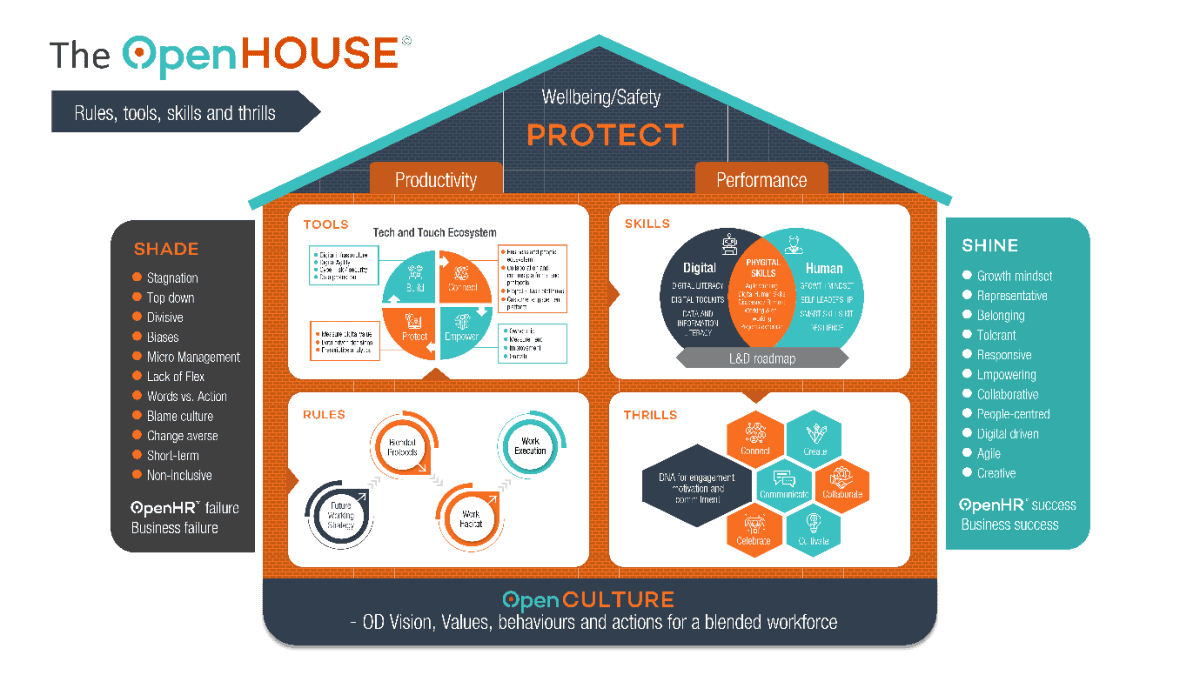
Inside the OpenHouse: Four Pillars of the OpenHR™ Framework
The OpenHouse is fundamentally structured into four key areas: Rules, Tools, Skills, and Thrills. Each of these “rooms” highlights the necessary strategies and actions to create an optimal work environment for a globally dispersed and diverse blended workforce.
1. Rules: This quadrant establishes a strategic framework that defines protocols and creates a workspace tailored to the diverse needs of all workers.
This room represents the cornerstone of aligning work strategies with the evolving landscape, ensuring inclusivity and adaptability.
2. Tools: This room reinforces the importance of building a robust, connected digital infrastructure to facilitate seamless communication, collaboration, and project execution.
This room underscores the importance of technology in fostering open communication and excellence in service delivery, with the customer at its heart.
3. Skills: This room helps HR leaders craft a forward-looking learning and development roadmap that empowers talent with the necessary skills to thrive in an ever-evolving dispersed and digital environment.
This room is all about equipping leaders, managers and employees with the knowledge, behaviors and skills to remain effective amidst constant change.
4. Thrills: This room highlights innovative ways to keep a dynamic and globally dispersed blended workforce motivated and engaged.
This room focuses on maintaining high levels of commitment towards common organisational goals, driving energy and enthusiasm across the workforce, regardless of whether being a permanent employee, part time or a skilled independent member of the team.
Building Foundations for Success: OpenCulture & Psychological Safety
An effective blended workforce thrives on an OpenHR™ framework rooted in OpenCulture. This framework aligns organisational strategy with execution through cultural evolution, clear communication of values and behaviors, and a foundation of trust and openness. It fosters a growth mindset, unlocking the potential of all employees, at all levels. This foundation binds both permanent and independent workers in a shared commitment to organisational goals, team goals and individual endeavour.
Protecting our blended workforce. Our strong foundation requires an equally robust roof that provides a psychologically safe environment for all team members, whether permanent or independent. This protective shield promotes openness, empowerment, collaboration, accountability and effective management, while safeguarding everyone’s physical and mental well-being.
Why Shift Now? Advantages of the OpenHR™ Approach
Organisations that successfully build and integrate their modern OpenHR™ framework can unlock numerous gains, including:
- A more adaptable and flexible workforce
- Enhanced engagement and satisfaction among workers
- Access to a diverse, global talent pool
- Empowerment that fuels innovation and experimentation
- Decentralized decision-making and horizontal management structures
- Performance support that prioritises growth over supervision
- High-impact collaboration and open communication across all employment types
- Providing meaningful work experiences to all workers
Open Talent in Action: Leading Case Studies
Procter & Gamble: Crowdsourcing for Innovation
Procter & Gamble (P&G), once seen as having a rigid employee structure, now embraces Open Talent. By using platforms like Kaggle and InnoCentive, P&G crowdsources solutions and innovates beyond its internal capabilities. This approach fosters collaboration, encourages innovation at all levels, and leverages diverse perspectives. At speed. Something many organisation can learn from and easily adopt.
Cisco: The Power of Talent Clouds
Similarly, Cisco: Through their “Cisco’s Talent Cloud,” they harness external freelancers and gig workers to fulfil specific project needs, enhancing agility and innovation for the benefit of customers and the injection of new thinking internally. This also builds a blended workforce community which can be oriented to new challenges, opportunities and special projects on-demand. Something those organisations who are not even aware of the Open talent revolution are missing, yet, in some cases, desperately need.
Risks of Traditional HR in the New Era

Failing to address the reality and strategic importance of the blended workforce can lead to significant challenges:
- Difficulty in attracting and retaining top talent
- Mismatched work expectations and value misalignment
- A tendency to view the independent talent as expendable or disposable. A short-term need regarded as project-based managed services only, rather than an opportunity to build longer term mutual loyalty and value creation
- Stagnation in outdated practices rather than forward-thinking leadership
- An unattractive employer brand and reputation
- Legal risks and potential damage to reputation
- Suppression of creativity and innovation
It’s the responsibility of HR professionals to lead our organisations into this new era of work, ensuring that we construct environments that support and nurture talent in all its forms. It’s time to embrace the OpenHR framework and build a resilient, diverse, inclusive, and thriving workplace for the future.
How to Implement OpenHR™: Strategies for Leaders
Embracing a blended workforce requires more than policy changes; it demands a cultural and operational transformation aligned with OpenHR principles. Here are key strategies for leaders to effectively integrate this approach:
- Cultivate an Inclusive Culture: Organisations must ensure that all workers, irrespective of their employment type, feel integral to the team. This calls for transparent communication, inclusive meetings, and recognition of contributions across the board.
- Harness Technology: Utilise collaborative platforms such as Slack, Teams, Notion, Trello and deeper project management tools like Asana to bridge the gaps between different worker types. These tools facilitate seamless communication, collaboration and project alignment.
- Define Clear Roles: Avoid confusion by establishing well-defined roles and responsibilities for every worker. Clear communication channels ensure all team members are aligned with organizational objectives.
- Invest in Development: Even if temporary, providing training opportunities for all workers can enhance performance and foster loyalty. This investment pays dividends when former contractors return due to positive experiences.
- Create support and Feedback Mechanisms: Regularly seek feedback from all workforce segments to refine processes and maintain a harmonious work environment. A two-way feedback loop adds value, offers opportunity for on-the-job coaching and moves the organisation from purely performance supervision focused, to being driven by performance support. For all.
- Adapt Leadership Styles in line with your blended workforce: Flexibility in leadership is vital. Different workforce segments may require distinct management approaches, from directive styles to empowered autonomy, to suit varied individual needs.
- Recognize Contributions: Develop recognition programmes to acknowledge the efforts of all workers. By celebrating achievements of everyone, organisations can boost morale and reinforce loyalty and be known for ‘catching people doing it right’
- Maintain a Strong Brand: Position the organisation as an employer of choice for all types of workforce participants. Building a reputation for fairness, respect, and opportunity attracts top talent across all employment categories.
This is the New Normal – Don’t leave it too late.
The independent workforce is no longer an ancillary option but an integral part of a modern organisational framework. Leaders must recognise that the future workforce encompasses more than traditional roles, requiring an inclusive approach across all levels and designations, providing opportunity for competitive advantage with customers and in the war for talent.
What’s in it for you and your organisation? The benefits:
- A Skills-based versus role-based workforce: This allows for the application of talent where it will have the greatest impact and benefit, rather than just filling for role vacancies.
- Agility and Flexibility: In a world marked by rapid change, a blended workforce empowers organisations to be nimble. An OpenHR™ framework allows businesses to scale operations fluidly and respond promptly to market demands, seasonal changes, and strategic shifts.
- Access to Specialised Talent: The rise of Open Talent introduces a realm of specialised skills that organisations can tap into on-demand. This flexibility enables companies to bring in niche or senior-level expertise without the commitment of full-time employment, fostering innovation and efficiency.
- Cost-Effectiveness: By employing a blended workforce, companies can reduce operational costs related to salaries, benefits, and physical office needs, allowing for more strategic resource allocation.
- Enhanced Engagement and Retention: Flexible work arrangements greatly enhance employee satisfaction, whatever their designation, leading to higher retention rates. By accommodating diverse working styles and preferences, companies can cultivate a more committed and cohesive workforce whether permanent, part time or independent.
- Driving Innovation: A mix of full-time, part-time, and freelance workers fosters an environment ripe for creativity and innovation. Differing perspectives and experiences lead to groundbreaking solutions and fresh ideas.
Alibaba: Transforming Collaboration with Open Talent Networks

Alibaba, one of the world’s largest retail and e-commerce giants, effectively utilises OpenHR to harness the power of open talent networks alongside its internal workforce. A prime example of this synergy is the Taobao Maker Festival, an annual event that highlights young entrepreneurs and creators. This festival allows these innovators to showcase and sell their products with support from Alibaba’s permanent employees and management.
Impact of the Taobao Maker Festival
Participant Growth: The festival attracts thousands of designers, inventors, and small business owners annually, demonstrating a rising interest from young innovators. With over 1,000 unique products introduced at recent events, Alibaba connects independent talents with internal expert teams to refine and accelerate product development.
Sales and Engagement: This collaborative approach enhances platform engagement and boosts sales, even for products with “unknown potential” in experimental phases. This reflects a Growth Mindset, as Alibaba embraces innovation at all levels, leading to increased visibility and sales of featured products, benefitting everyone involved.
Innovation Pipeline: By integrating permanent employees with an expanding open talent network, Alibaba expedites the creation of new marketplaces, products, and services efficiently and cost-effectively. This enables rapid innovation, fueling growth across various sectors.Through adopting the OpenHR framework, Alibaba efficiently manages a blended workforce, fostering collaboration and empowerment for all team members.
By redefining management roles as performance supporters rather than mere evaluators, Alibaba cultivates a culture of innovation and mutual success. This approach not only boosts productivity but also ensures harmony and sustained growth for the organisation and its workforce. Regardless of whether permanent or open talents.
Final Words: Embracing the Future of Work
The shift towards a blended workforce, buttressed by an OpenHR framework, is an inevitable and transformative journey for modern businesses. By embracing this trend, organisations can build agile, innovative, and resilient teams capable of navigating the complexities of a digitally enabled world.
The future belongs to those who boldly integrate diverse talent, harness technology, and foster an inclusive, collaborative and engaging work culture.
Forward-thinking leaders who adapt to these changes will not just survive, but thrive, in the rapidly evolving landscape of the Open Talent era.
See Jeremy Blain’s speaker profile and hire Jeremy to speak at your conference or retreat on this topic and many others.