
Rapid change in today’s business landscape demands organizations rethink how they are structured. Rita McGrath’s expertise offers clarity and practical direction, helping leaders navigate these transitions with confidence. Widely acclaimed for her work in innovation and organizational leadership, Rita combines real-world insights with a forward-thinking approach to modern design. She guides teams to cut through bureaucratic barriers, embrace flexibility, and empower individuals to succeed in dynamic environments.
Breaking Free from Bureaucratic Limits
Rita highlights a growing realization: traditional hierarchies and rigid bureaucracies simply aren’t suited to the pace and complexity of modern business. Drawing on insights from industry leaders, she notes that the competitive advantages of reliability and control have given way to the need for adaptability and speed.
- Hierarchical “command and control” structures were once effective, particularly in contexts with limited information and low-skilled labor.
- Rita cites Bill Anderson’s perspective—today’s organizations require a very different approach, emphasizing flexibility over rigid rules.
- Bureaucratic barriers stifle creativity, slow decision-making, and frustrate teams that want to move quickly.
Direct Responsibility and Team Empowerment

Using Toss, a South Korean fintech company, as a standout example, Rita explores how new models of organizational design are revolutionizing the way work gets done.
She highlights how Toss’s agile, decentralized approach enables it to respond rapidly to market changes, experiment boldly, and empower employees, reflecting the more adaptive, technology-driven economy that is replacing the traditional petrochemical-and-mass-market paradigm.
- Toss is built around “Directly Responsible Individuals”—small, empowered teams that own outcomes and access resources directly.
- The company thrives on innovation, with team members at the cutting edge and energizing environments where entrepreneurial drive is valued.
- Rita asserts that environments favoring autonomy and self-organization nudge people out of restrictive boxes, sparking greater engagement and creativity.
Decoupling for Flexibility
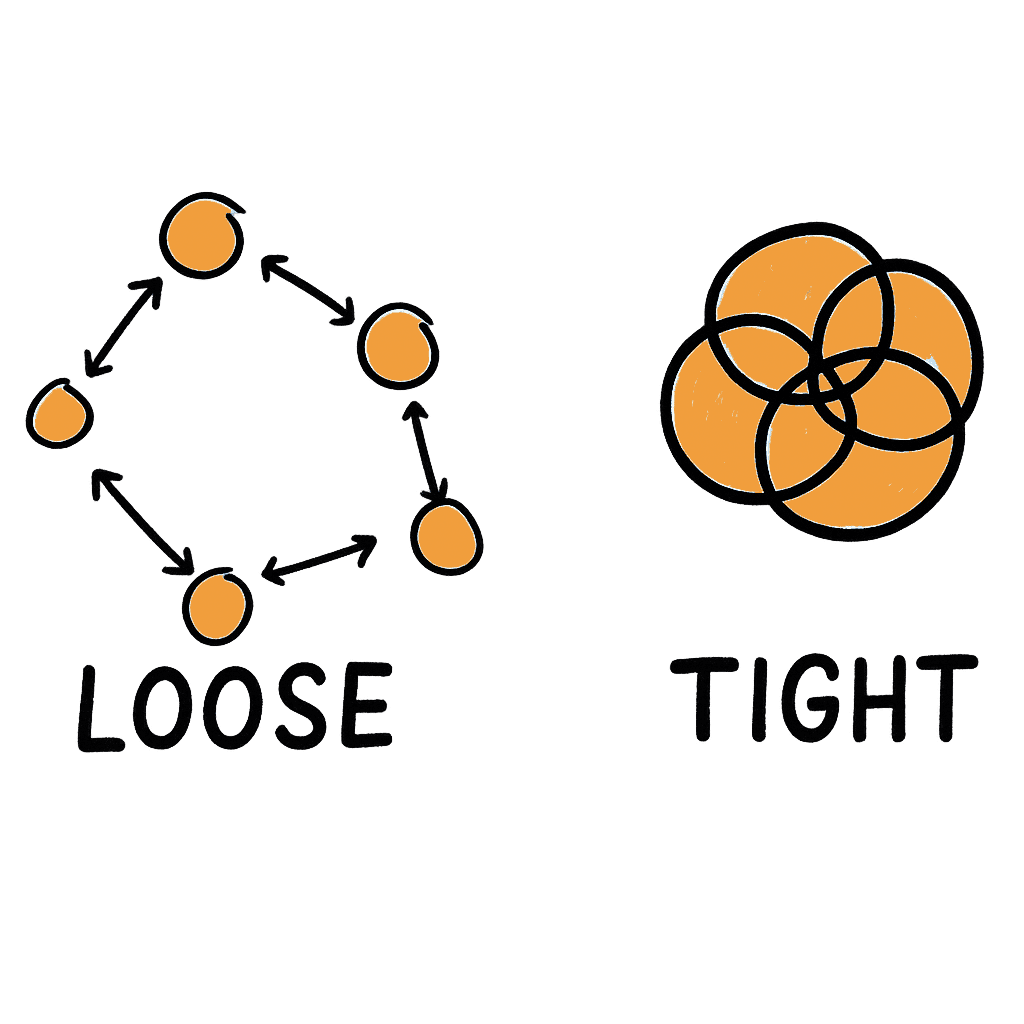
Rita introduces the concept of “loose versus tight coupling,” borrowed from computer science, to explain the pros and cons of interdependencies within organizations.
She notes that tightly coupled systems can create efficiency but reduce flexibility, while loosely coupled systems allow teams to experiment and adapt quickly, though they require more coordination to stay aligned.
- Tightly coupled systems work in stable environments but can be vulnerable to cascading failures when change accelerates.
- Large organizations often over-couple processes, leading to unnecessary dependencies—each decision becomes mired in coordination, slowing progress.
- Rita references Amazon’s “two-pizza teams” principle, emphasizing the power of keeping teams small to facilitate fast communication and rapid innovation.
Designing for Emergence and Innovation
Modern organizations, according to Rita, benefit most from making space for emergence—where innovation bubbles up from empowered teams rather than being dictated from the top.
- Value creation shifts from giant corporations to networks of small, agile firms collaborating in ever-changing ecosystems.
- Teams need freedom to make decisions closest to where action happens, not centralized control from distant bureaucracies.
- Rita suggests that government and business could learn from seamless experiences—like automatic teller machines—where complexity is managed behind the scenes, sparing users unnecessary friction.
Key Insights from Rita
- Agility and autonomy fuel innovation, while bureaucracy impedes progress.
- Empowered, small teams outperform rigid hierarchies in dynamic markets.
- Flexible organizational design enables rapid decision-making and adaptation.
- Leaders should scrutinize their organization’s dependencies and streamline processes to remove barriers.
- The future of value creation belongs to networks, not monolithic firms—the best organizations will be those that embrace change, foster creativity, and enable teams to make meaningful decisions.
Building the Future with Agility
Rita McGrath’s insights inspire leaders to rethink how their organizations are designed, emphasizing agility and direct responsibility. By dismantling bureaucratic obstacles and empowering small teams, organizations can unlock creativity and resilience—setting the stage for lasting success in an ever-evolving landscape.
Her guidance points confidently toward a future where innovation thrives, not in spite of change, but because of it.